
50th Queen's Own Regiment embarked from Sydney for
India the month of February 1841 in two ships, the Lady
McNaughton and Crusader, and arrived at Calcutta on the 19th
April 1841.
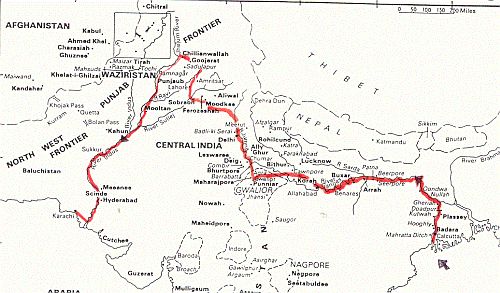 We were sent to a station called Chinsurah, 22 miles
from Calcutta, a most unhealthy place on the banks of the
Hoogly River. The Regiment had no sooner landed than the men
were attacked by cholera, which struck terror into the men,
as they had been healthy in Australia, with scarcely a man in
hospital. A man would be taken suddenly ill with cholera in
evening, sent to hospital and be dead and buried by six or
seven the next morning.
We were sent to a station called Chinsurah, 22 miles
from Calcutta, a most unhealthy place on the banks of the
Hoogly River. The Regiment had no sooner landed than the men
were attacked by cholera, which struck terror into the men,
as they had been healthy in Australia, with scarcely a man in
hospital. A man would be taken suddenly ill with cholera in
evening, sent to hospital and be dead and buried by six or
seven the next morning.
However, the Regiment was ordered to Fort William,
Calcutta, and there the cholera was nearly as bad, men being
taken to the hospital at Kederepore, and never saw the
Regiment again, being dead and buried or invalided home.
At length the Regiment was ordered to Moulmain, as it
was expected we should go to war with Burmah. The Regiment
sailed in three vessels, two sailing ships and one steamer.
Of course, we expected the sea air would have rid us of the
plague, but when the steamer passed us on the passage she
reported having eight men lying dead on her decks.
At last we arrived at Moulmain, and went into camp. It
was an old burying ground, that was used by the General
Hospital in the war time of 1824-25-26, so I concluded there
was a good number of deaths in the three years' war, for on a
dark night you would go into a hole up to your body, and you
were very lucky if you did not get a sting of a Scorpion or
Centipede or the bite of a snake.
However, there was not to be any war with Burmah, and
we were shifted back again to that Golgotha Chinsurah, where
we had another attack of cholera. A small incident occurred
to myself one day. The men were ordered to receive their pay
every day at 12 noon. An Officer was to be present at the
payments. I had felt myself rather queer in the morning, and
I went to the hospital to get a dose of medicine which I got
and it made me feel queerer. Pay time came and I was called.
The Captain looked at me, and said, 'Pelvin, you don't look
well.' I told him what I had done, and he said, 'You must go
back to the hospital. I said I was all right. The Captain
called a Corporal and two men and ordered them to take me to
Hospital at once, whether I liked it or not, and the doctor
kept me in hospital for three days. That was the first and
last time I was in the hospital, for many years.
Our next shift was to that renowned place, Cawnpore.
In those days (1842) locomotion was not so far advanced as at
present. We were to go by native boats a distance of 600
miles, and all against the stream. Our progress, you may be
sure, was very slow, as the Hoogly and the Ganges are very
rapid rivers, but such a sight you never saw. There were
upward of 100 boats to take one Regiment. There was
Officers' Budgerous barges, the Hospital boats, Men's boats,
Cooking boats, Store boats, all sorts and sizes, but not one
with a keel to it. They all had either round or flat
bottoms, and if caught in a gale over they must go.
An incident of this sort occurred to us between Benares
and Patna. This Great Fleet was plodding along at a snail's
pace one day, when a gust of wind caught a mat sail, and
tumbled the boat over with a number of soldiers in it. Some
tried to swim, but got exhausted and were drowned. Others
stuck to the boat, and after going many miles down the river
got saved by the boat grounding. The boat I belonged to
happened to be behind the Fleet, and we picked up several,
who told us that many native boats passed them and would not
pick them up as they worship the Ganges.
The boats always stopped at night, fastened to the
banks of the river by posts and ropes, off again the next
morning, and the current was very strong, would make but very
little headway by night as you could see the place you used
the night before. It took the Regiment months by this sort
of travelling to travel 600 miles. We passed by Dinapour,
Benares, Allahabad, and other small towns en route.
Having arrived at Cawnpore, then an Independent
Kingdom, we remained in Barracks until the War broke out with
Gwalior, a small Independent State. The army was divided
into two parts, or wings. The right wing was commanded by
Sir Hugh Gough, Commander in Chief, the left wing was
commanded by Major General Sir John Grey. We remained in
camp at a place called Duboy, in the Bundelkhand, a district
on the Frontiers of Gwalior. On the 29 December 1843, the
right wing, under orders of the Commander in Chief, attacked
the Maharattas at the village called Maharajpore, the
Governor-General, Lord Ellenborough, being present. The
enemy stood their ground well, but was forced to retire with
the whole of their cannon taken, and made for the jungle.
On the same day, December 29, 1843, General Grey
attacked with the left wing the village of Punniar, above the
Maharattas, who were 13,000 strong with a good strong
artillery force. After fighting desperately they abandoned
the whole of their cannon taken and their army scattered.
1st Irish were allowed to have a contingent, which made us
pay dearly for it during the mutiny of 1858, as they drove
their Rajah off his throne, and he had to fly to the British
for protection, and his army joined the mutineers. 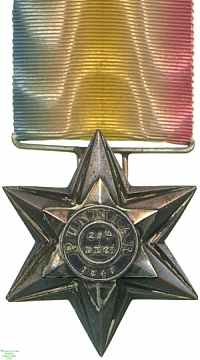
Lord Ellenborough was so proud of the gallantry
displayed by the troops at Maharajpour that he recommended to
the Imperial Government at Home to have a Star of Bronze made
from the enemy's captured guns for the army of Gwalior, one
of which I have the honour of wearing.
Lord Ellenborough did not remain Governor General of
India long after this as he was superseded by Lieut. General
Sir Henry Harding sent out in his place. After this the
troops returned to their respective stations and we went to
Cawnpore, also the 9th Lancers and 40th Foot with 16th
Lancers to Murat, 3rd Buffs to Agra and 39th to Allahabad.
Lord Ellenborough was a great man with the Army and I believe
would have made a good General.
Having a relation in the 16th Queen's Lancers, I had
been trying for a long time to get to that regiment, but our
Colonel would not let me be transferred on account of the
regiment being so much under its strength. However, in 1844,
we had several strong drafts of recruits from Home, and I
again applied for transfer, which the Colonel sanctioned and
I was transferred to the 16th Lancers at Meerut on the 1st
July 1844, remaining with myoId regiment until an
opportunity should occur of joining my new one in a few
months. I occurred a Corporal of the 40th regiment came to
Cawnpore with a prisoner, and I had the chance to join my new
regiment, which was 300 miles up and 900 miles from Calcutta.
Having joined by new Regiment, I was very much struck
with the relaxed state of discipline in the cavalry regiment,
but they were a fine body of men, men generally speaking of
good education, and what you may call devil-may-care sort of
fellows, full of life but very fond of the soldiers' canteen,
which got many of them into trouble. I will give you an
instance of one; it was a man of good birth and education.
His name was Charles Percival. He was in Christchurch when I
arrived in this country (NZ). Perhaps some of the old
identities knew him, as he had a brother or cousin who had a
sheep station in the McKenzie Country. Charley took up the
profession of a Military Lawyer - the worst profession any
many could undertake - always getting into trouble and always
under some minor punishment. But one good thing he did for
his comrades, and the regiment in general.
At one half-yearly inspection by the General of the
District, the men are always asked if they had any complaints
to make. My bold Charley stepped out and said he had. "What
is it, Percival?" says the General. He (Percival) made a
claim for sashes, cap lines, boot straps and etc, that had
not been issued to the men for two or three years. The
(Colonel Caseton?) was asked what sort of a character
Percival had; and you can rely upon it Charley did not get
the best.. The General said, "Now Percival, I am bound to
forward your claim to the Horse Guards and if it is false or
not true, I will have you tried by General Court Martial."
In course of time, an order came from Horse Guards that all men of the 16th Lancers to be paid compensation for
all necessaries that had not been issued to them, so Charley
got off with flying colours. He lived to go through the
Sutlej Campaign when the Regiment broke up in 1846 and I
volunteered to the 3rd KIngs Own Light Dragoons.
When the 16th arrived at Portsmouth a carriage and pair
drove up to the barracks and took Charley home. I heard no
more account of him until I came to New Zealand when a man
living in Timaru, of the name of Manning, from Christchurch
told me he knew him well, and his parents sent him out here
with 7,000, which he ran through, got another 7,000 from
Home and squandered that the same as the first. The Rev G.
Parson Foster knew him well, and he told me that Charley
Percival did not know the value of money.
The 16th Lancers remained at Merrut until the end of
December 1845, when the war broke out, the Sikhs of the
Punjab, crossing the river Sutlej, and attacking our army at
Moodkee, while the troops were cooking their dinner. Of
course, the troops got under arms at once, but our force was
very small in comparison. Under command of Under Major-
General Sir John Little, with only 5000 men and 21 guns, when
they gave them a complete check; and sent them back to their
entrenched camps at Ferozeshah The garrison from Umballa not
having reached the front. 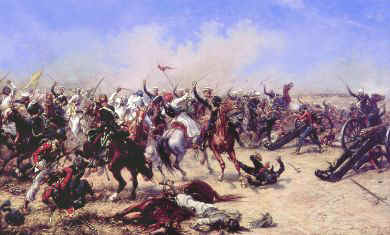
The Sikhs at Ferozeshah made a great stand. The Meerut
division was ordered up to the front by forced marches and at
four o'clock on the afternoon of 21 December 1845, Lord
Gough, with 16,700 men with 64 guns advanced to the attack of
the Sikhs' formidable entrenched camps. Daylight having near
gone, both armies lay on their arms all night. Lieutenant-
General Sir Henry Harding took the command. He was Governor-
General of India at the time - a gallant soldier.
In this engagement we lost 694 killed and wounded,
1721. Prince Waldman of Prussia was in this engagement. I
was not in these two engagements as the 16th Lancers, which
was with the Meerut Divisions, did not get up in time. The
Sikhs lost 67 pieces of cannon at Ferozeshah, and 17 guns at
Moodkee.
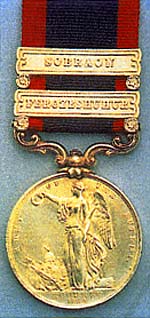 The retreat of the Sikhs from Ferozeshah, the army a
short rest, and then took up a position at Sabraon, a village
on the banks of the Sutlej River, and made a very strong
entrenchment there. So strong, in fact that our leading
Brigade could not get into it, so the army waited for some
heavy battering guns from Delhi. By the time the Meerut
division had arrived at the front, and as the cantonement of
Loodiana was in danger of being attacked, and the enem}- was
on our side of the river, we were ordered off to its
protection as there were no troops there but one Seapoy
regiment, and women and children under the command of General
Sir Harry Smith. Also some recruits and women and children
from England.
The retreat of the Sikhs from Ferozeshah, the army a
short rest, and then took up a position at Sabraon, a village
on the banks of the Sutlej River, and made a very strong
entrenchment there. So strong, in fact that our leading
Brigade could not get into it, so the army waited for some
heavy battering guns from Delhi. By the time the Meerut
division had arrived at the front, and as the cantonement of
Loodiana was in danger of being attacked, and the enem}- was
on our side of the river, we were ordered off to its
protection as there were no troops there but one Seapoy
regiment, and women and children under the command of General
Sir Harry Smith. Also some recruits and women and children
from England.
On the march, we went by forced marches. The day we
reached Loodiana was a most terrible march. The Infantry was
complete exhausted, and the Cavalry were tired sitting in the
saddle. We had been marching from 2 o'clock in the morning
when the troops came to Budiwall (or Budiwah) about three or
four o'clock in the afternoon. A force of Sikhs was in
Budiwall, but our force, being so fatigued that he dare not
attack them, and we had to make a long detour to get clear of
their fire. The Cavalry had to make feints to clear their
fire on us. The consequence, the Infantry got round and the
poor recruits and women and children were so exhausted that
numbers of them lay down on the dry plain and were taken
prisoner.
When we got clear of the enemy, all those that could
not proceed, the Cavalry dismounted their horses and put them
on their horses, and led the horses until we came to the
camping ground. I dismounted and put a very young recruit
into the saddle, and led the horse. I must give the Sikhs
great credit for their humanity, for when the war was all
over the whole of the men, women and children were returned
without being ill-treated.
Our next little game was to settle with the Budiwall
Sikhs after delivering food and we stopped in camp for two or
three days. In the meantime they shifted their quarters to
the village of Aliwal, between Loodiana and our camp and near
the Sutlej river. 
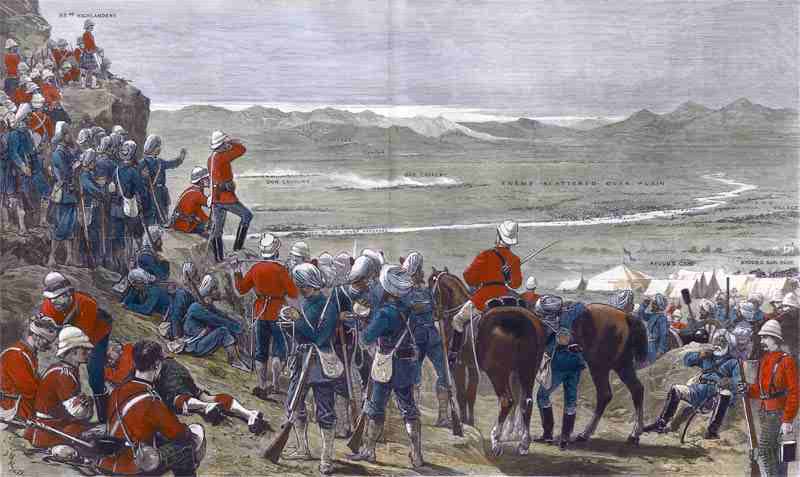
On January 28th 1846, Sir Harry Smith moved down to
attack the Sikhs. It was a beautiful morning, and about 2
o'clock we came in sight of their camp and the plain was
level as a bowling green, but there were deep watercourses or
nullahs running through the plains Before we got in reach of
their fire their guns opened upon us, and it was a curious
sight to see the Infantry all lying flat down when they came
within reach of their cannon, while the Cavalry had to sit
still and receive their fire, having a man knocked over here
and another there and a horse here and there. At last we
were ordered to advance but still keeping in line with the
Infantry on the left flank to prevent the enemy from
outflanking us.
At last we came to a tope of trees, which a squadron
was ordered to clear and it was full of the enemy, - a very
bad place for Cavalry to act in, as we could not act
together. We routed them all out after some desperate
fighting, and we dare not follow them up. We had to return
and take our place on the left of the line. We lost about a
dozen men in that affair, but the enemy paid for it dearly.
The Infantry and Horse Cavalry charged the village of Aliwal,
and completely routed them, taking 52 guns, and we followed
them up arid the Horse Artillery and Cavalry also the taking
of their camp.
We also took a European, an East Indian Company Horse
Artilleryman, who had deserted some years before. He was
made a prisoner and brought before Sir Harry Smith and sent
under a guard to one of the regiments, but what became of him
I don't know.
My poor rear rank man, Ben Smally, was shot in the
chest, a nice quiet Yorkshire man, and died in the General
hospital and the Army marched back to Sobraon.
The Commander-in-Chief having received his heavy guns
from Delhi, attacked the Sikhs' entrenched camps at daylight
on 10th February 1846 and cut away the centre of their bridge
of boats across the Sutlej River, one of the strongest rivers
in India, the current running something like in the Waitaki
River here. Of course the enemy's retreat was completely cut
off which made them thoroughly desperate and they fought with
desperation. They were the best troops in the enemy's army.
The Kahlsa troops fully thirty thousand strong with 70 pieces
of cannon, with a reserve on the opposite side of the river
and as there was a ford lower down it was expected that the
enemy would cross the river at this ford, and come to the
assistance of their Army when attacked by us if required.
Our Brigade of Cavalry with a battery of Horse
Artillery, was ordered down to this ford. They unlimbered
their guns and sent us a few shots across, which dropped
short. They ceased firing and remained watching us until
Sobraon was taken, but these same troops made us pay dearly
for it at Chillianwalah, in the campaign of 1848 and 1849.
Now to return to Sobraon.: - Mind you, these troops
were not common native soldiers, they were disciplined French
Officers, and had their Bands and Officers and colours the
same as any European regiment and as brave soldiers as any
men in the world, which they proved in the campaign of 1848
and 1849.
When the campaign of 1845 and 1846 broke out, the
European Officers all retired from the Sikh service. Only
the officers' names I can remember are Generals Ventura and
General Avitable and entered our service after this war. I
believe the taking of Sobraon one of the greatest battles
ever fought in India and with the greatest loss of life to
the enemy and terrible heavy to the British troops.
Sobraon. As I said before, the action commenced at
daybreak on the morning of the 10th February 1846, and was
ended about 11 a.m. The total loss of the British was:
killed, 1320; and wounded, 2063. The Sikhs, in their efforts
to cross the bridge of boats that was cut away, hundreds upon
them was drowned in the river, swimming to get to the bank on
the other side, and I believe the Sikhs themselves owned to
the loss of 14,000 men.
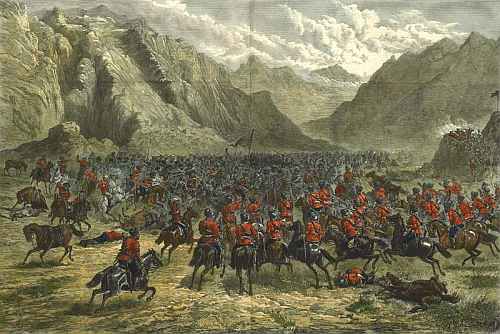
I went down to the entrenchment camp after the action
was over, and such a sight I never anticipated, but once seen
at Chillianwallah. Men were blown up with rockets bombs,
shells, grape and shrapnel and almost any projectile you can
mention. I may say thousands upon thousands were driven into
the river like a large flock of sheep. The sight was awful,
yet the Sikhs were that brave they would not surrender or put
up a flag of peace, but would prefer death. And they are now
at the present with the Gourkas,the bravest and most reliable
native soldiers we have in British India, and as good or
better than some European nations.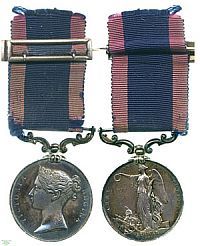
Well we crossed the Sutlej the day after the fight,
into the Punjab, and made for their capital, Lahore, when the
Ranee or Queen Mother sent to implore the forgiveness of the
British, by Golab Sing Rajah of Junmu and Cashmere, so peace
was proclaimed. (So the political I leave to the
politicians.)
And that is how our army went into Standing Camp while
the 16th Lancers, were ordered Home, after 25 years' service
in India. A Cavalry Regiment in India being double the
strength of a Cavalry Regiment at Home, being 700 strong,of
course we should have a greater number of men to spare, the
consequence the men are allowed to volunteer to any Cavalry
Regiment in want of men, and each man receives a small bounty
at the volunteering time. I made up my mind I would
volunteer, so I joined the 3rd King's Own Light Dragoons, and
had another seven years in India.
So the standing camp was broken up, and the Army went
to their respective stations. I went to Amballah with my new
Regiment, and there settled down to garr~son duty and barrack
drill. Having a large number of young horses to break in we
had plenty of riding school.
The 3rd King's Own Light Dragoons remained at Amballah
during 1846, 1847 and part of 1848, when our second campaign
took place when Runjeet Sing was living,the only man that
could command the Sikhs and keep the Punjab in order was
dead. The Sikhs' chiefs and army still considered themselves
invincible. As we had had some very serious losses in
Afghaniston, they thought very little of our valour, and
treated us with contempt, which they let us see in the second
campaign, to their grief.
While we were at Amballah in cantonements, a force from
Bombay, which was under command of General Whish, a gallant
regiment of ours came from Poonah to replace the 16th Lancers
which had gone Home. They laid in the same cantonement with
us, and had one half of our barracks at Amballah. This
regiment had never been under fire or on a campaign since the
Peninsula war. Of course, the men would boast very much of
what they would do, and what they would not do (and they were
not going "to take medals for picking off black men) in case
they had an opportunity of meeting the enemy in the field.
We had no idea that we were going to make another
campaign into the Punjab at this time. All went very
smoothly until the second campaign opened, and of course this
gallant regiment of cavalry was real hot to meet the enemy.
They were in General Pope's Brigade, and we will leave them
there for the present.
Well, the campaign broke out again in 1848 on 2nd
December. Our army was at Ramnagag on the banks of the
Chenab, one of the five rivers of the Punjab. Their main
army lay on the other side of the river, but they sent a body
of cavalry and infantry to the side of the river we were on.
Their infantry lay in ambush at the rear of some sandhills
and some distance from their cavalry.
The Sikh's cavalry advanced to the front, and this
cavalry brigade of ours asked permission to be allowed to
charge. the Sikhs cavalry. They got it and did charge
splendidly. The Sikhs' cavalry turned about, and Pope's
Brigade after them until they came on the infantry under the
sandhills. The infantry opened upon them a most destructive
fire which killed a number of our cavalry officers, men and
horses. The enemy eventually took to flight and crossed the
river to their army and Pope's brigade returned but their
Colonel was killed, also Brigadier General Cureton and his
youngest son and other that I do not remember. So that was a
lesson they did not forget for a long time. They adored
their colonel, and Brigadier-General Cureton who had
commanded the 16th Lancers for many, years. His youngest son
was deeply regretted.
Our next move was to cross the river Chenab by a ford
lower down the river and try to outflank them. Our brigades,
and some batteries of horse artillery and some brigades of
infantry crossed to the other side, and when the enemy saw
what we were up to, they struck camp and marched off, and the
main army crossed over, and our outflanking party met them,
and we joined the main force again. (This action is not
recorded.)
The enemy then made for the jungle at Chillianwallah,
where they pitched ,their camp and where Sir Hugh Gough made a
very grave mistake. It occurred in this way. The Commander-
in-Chief was out reconnoitring with his staff, when a shot
from one of the enemy's guns fell in amongst him and his
staff. This got the old Tipperary man's blood up. He at
once ordered the army to advance - they did so but a more
miserable country could not be imagined., a nasty place with
trees about 20 or 30 feet high, with thorns as long as your
finger. The horses (all entires) forced and forced their way
amongst the trees, biting and crushing each other enough to
take a man out of his saddle. Our position was again on the
extreme left of our army and the right of the enemy, where
they had a battery of artillery firing on our regiment, and
we had to' move our position which is a position not to be
envied by anyone, as we could not see them, but only the
flash of their guns.
There we sat still in our saddles like statues, as a
target to be fired at. The men grumbling at not being
allowed to move. The consequence was that presently a shot
came from their battery, and struck me right in the centre of
my shako, so suddenly and made such a hollow sound, having
cut the strong of the lining away, that the shako came over
my eyes, and of course I could not see for a time. I accused
my right hand man for knocking my shako down over my eyes
with the back or flat of his sword. Of course he denied it,
and told me to take off my shako and look at it. I did so,
and to my astonishment a nine pound shot had cut the crown out
of the number plate. (You may ask what I did with it, well I
just threw it away, and put on my forage cap.)
Shortly afterwards we were ordered to take ground to
the right. Another shot came into the regiment from the same
battery and went through three horses and they dropped like a
shot as they saying is, without injuring any of the riders.
The riders, of course, made to join the infantry, as a
cavalryman is not much without his horse.
Being isolated and on foot this troublesome battery at
last got its desserts. The grey squadron on foot was ordered
to make a detour around to the extreme right of the enemy,
and attack their guns. They got round, and charged them,
drove the enemy from them and spiked the whole of them - that
is they put a jagged spike in the touch-hole, which cannot
be withdrawn.
On the other part of the line, the action was far more
serious. The whole line advanced. I think I had better
refer to history for the remainder of the action, as a
soldier in action has enough to attend to the orders he
receives in such an action as this was, where you could not
see 50 yards in front of you, as was the case at
Chillianwallah.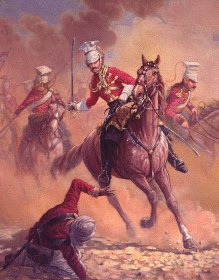
Lord Harding, in his dispatch relating to this action,
charged Lord Gough with indiscretion of the most serious
character, in attacking the enemy when the day was far spent,
the troops wearied, and no time to make preparation to avoid
unnecessary loss, without any reconnaissance, and added to,
"his indiscretion cost us dear."
Had the result been otherwise, Lord Gough would have
been praised for the dash he displayed in attacking the
Sikhs, and in spite of all the above-named disadvantages, for
having routed them utterly. The fact is, he came on them
rather suddenly, and Lord Harding suggests that the Irish
blood of the old soldier was irritated by the fire from their
artillery as he was reconnoitring.
Gough opened a cannonade which lasted an hour and a
half, then moved his left 3rd and 4th Brigade to flank the
enemy. In doing so it was terribly mauled by the enemy from
concealed batteries, and when the troops got up to the guns
they retired rapidly. The 5th Brigade under Mountain, carried
the guns in their fronts, but the Sikhs' infantry opened such
a fire of musketry on their flank and rear that they too
retreated in haste, but in good order. On the extreme right
Godby's Brigade were received with equal firmness, and
outflanked and attacked in the rear by the Sikhs.
In the melee the 2nd European East Indian Company
especially distinguished themselves by charging, rear and in
front, and checking the enemy, but the cavalry on the extreme
right, under Brigadier Pope, being ordered to charge, the
enemy's horses, faced about and left the field (with the
exception of a party of the 9th Lancers, who were rallied.)
This is an error. The 9th Lancers were not in Pope's
Brigade. I have been in several engagements with the 9th
Lancers and in several actions and they never retreated
before an enemy. It was another regiment that was in Pope's.
I am sorry to say that I am not at liberty to expose them, as
being a pensioner, I may get into trouble over it.
The runaways made right for the three troops of Horse
Artillery, which had been placed in support in their rear,
dashed right through them, upsetting waggons and horses, and
scurrying through the hospital tents,pulled up exhausted and
discredited, leaving the field of battle far behind.This
panic, so unaccountable and unusual, a serious loss for the
Sikhs captured the guns, two of which only were retaken, and
cut down 70 gunners. The British, however, remained masters
of the field, but 26 officers and 731 rank and file of the
European troops were killed; 66 officers and 1146 were
wounded. Four of our guns and five stands of colours. The
Sikhs might well have claimed a victory, which they did, for,
after the action was over, they fired a Royal Salute of 21
guns.
The Sikhs resolved to march off at night, taking with
them the guns. rhus ending the battle of Chillianwallah,
with what a sacrifice of life.
Allow me to give a bit of advice to those who advocate
war, and come with me over the battlefield the next morning
and I believe it will cool their ardour for wars.
My regiment, the 3rd Light Dragoons, was ordered out
with a battery of horse artillery to reconnoitre. We went
through the ground the battle was fought the day before, and
such a sight I am sure they would never forget till their
dying day - soldiers lying dead in all directions and in all
positions, some at full length on the ground face downwards,
others on-their backs, others with their knees drawn up and
hands clenched together in mortal agony at their last gasp.
Many of these men and officers I have no doubt would have
been saved if we had had daylight, but it was coming dark.
To give an instance of the severity of this action -
the First Battalion of the 24th Regiment that went into
action 1300 strong, they had 13 officers killed and 500 rank
and file killed and wounded. Colonel Pennycuick and his son
and 11 other officers were killed at the same time. The
other regiments, both European and native, in proportion. I
hope to God that the inhabitants of New Zealand may never see
such a destruction of life, although I do not believe in
peace at any price and if I was young again, I might be
induced to join the army again, although it is now nearly 40
years since I left the regulars.
So much for the Battle of Chillianwallah, one of the
hardest battles that has ever been fought in India and under
the most disadvantageous circumstances. When the news of
this action reached England there was a loud outcry against
Lord Gough, and a demand, almost unanimous, was made for his
recall, to which the Government acceded. The Duke of
Wellington sent for Sir Charles Napier, who announced his
readiness to start at once; and he was sent out to India to
supersede Lord Gough as Commander-in-Chief at once.
But ready as old fighting Charley was, the distance to
India interposed an obstacle which saved the gallant soldier
who was to have thus been disgraced, from a bitter
mortification, and which enabled him to retrieve his fortune,
and deliver a death blow to his determined enemy.
It was necessary for Gough to give his troops rest, and
make good damages and restore confidence to his army and for
nearly a month, the British General watched the Sikhs who
manoeuvred behind a great cloud of cavalry. On the
12thFebruary the Sikhs evacuated their fortified camp,
compelled possibly by scarcity of prov,isions, and marched
towards the ford of Wezerabad on the Chenab. Here they were
headed by Wished's force from Mootlaw, and they there, on
20th February, took up a position of Goojerat, between the
Chenab and the Jhelum.
Shere Sing now united had about 60,000 men of all
sorts, but only 59 guns. Lord Gough resolved to attack the
next day. He had with him about 25,000 men, but on this
occasion he had the advantage of high ground, as the Sikhs'
artillery was badly placed and exposed to the superior
service and action of the British guns, which far outnumbered
them. Gough halted his infantry out of fire and advanced his
guns.
"The cannonade," he says, "now opened upon the enemy
was the most magnificent I ever witnessed, and as terrible in
its effects." The Sikhs' guns were served with their
customary rapidity, and the enemy well and resolutely
maintained their position, but the terrible force of our fire
obliged them, after an obstinate resistance, to fall back. I
then deployed the infantry and ordered a general advance,
covering the movement with my artillery as before. Penny's
Brigade of the 2nd Europeans, 31st and 70th Native Infantry
Part of Harvey's Brigade, led by Franks, with Her
Majesty's 10th, broke in upon the centre of the enemy's
lines, and as the Campbells Lord Clyde's Division came
sweeping round the town of Goojerat on one side, and the
Bombay troops on the other, the Sikhs gave way and fled in
utter rout, leaving in our hands all the guns but two, and
enormous quantity of ammunition etc. This great victory was
gained with the loss of five officers killed and 24 wounded,
and 92 killed and 682 men wounded. The pursuit was vigorous,
but the enemy, pouring through the Khoree Pass, succeeded in
crossing the Jhelum river and General Gilbert did not succeed
in getting over with his light guns until the 5th March, when
the British prisoners of Attock, who had been in the hands of
the Sikhs, came into camp to announce that Shere Sing was
ready to lay down his arms. On the 14th, the Khalsoo passed
through our lines, unarmed and broken.
The immediate consequence was the annexation of Punjab.
The Governor-General issued a proclamation, in which he said:
"The Government of India has no desire for
conquest now, but it is bound in its duty to provide
fully for its own security, and to guard the
interests of those committed to its charge. To that
end, and as the onl.y sure. mode of protecting the
State from the perpetual occurrence of unprovoked and
wasting wars, the Governor-General is compelled to
resolve upon the entire subjection of a people their
own Government has long been unable to control, and
whom, as events have shown, no punishment can deter
from violence, and no acts of friendship conciliate
to peace.
The Maharajah, Dhuleep Sing, was treated with
consideration, but Moolrag, the ex Wewan of Mooltan, was
found guilty of aiding and abetting in the murder of Mr Van
Agruw and Lieutenant Anderson, and was sentenced to
imprisonment for life. Votes of thanks to the officers and
men of the British Army engaged in the campaign in India were
agreed to by both Houses of Parliament, and Lord Gough was as
much eulogised as he had been censured.
So poor old Charlie Napier had no show of a fight. He
passed the station in which my regiment was, and nobody knew
who he was. He went to the sergeant of the main guard and
ordered him to turn out the guard, telling him who he was.
The guard was turned out with the colours. The old General
nearly cried over them. He was major in the regiment at
Corunna. Thus ended the second campaign against the Sikhs -
as brave a race of men as can be, and who stuck to the
British throughout the whole of the mutiny.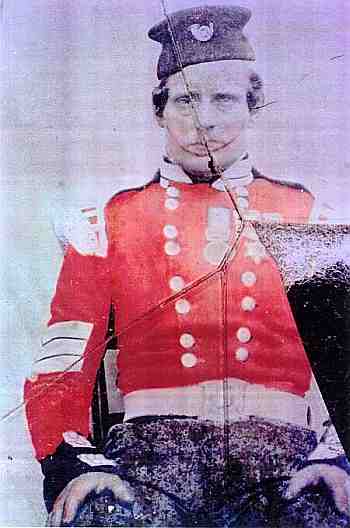
Our regiment was ordered back again to its old station
at Amballa.h for a short period, where we went into cantonment
again, which we found very tame and quiet, with plenty of
breaking in young horses, riding school and foot drill.
We got our six months batty money. As most persons
may not know what batty means I will explain what it is.
Money allowed by Government when an army has been on
campaign and succeeded. Each man gets 38 rupees, counting
each rupee as two shillings, or 3.16.0 each for the six
months. For the campaign of 1845 and 1846 the army got 12
months' batty, 76 rupees or 7.12.0. but what an army that
does not succeed gets I cannot tell as I never knew; but I
don't think much. However there is always an allowance of
liberty allowed at those times, for the sooner the money has
gone the better.
Our next move was back again into the Punjab to a place
called Wuzeerabed, near the river Indus, doing a sort of
garrison duty until the beginning of 1853, when our regiment,
3rd Light Dragoons, broke up for Home, when we opened for
volunteering. The men could volunteer to any Cavalry
Regiment they liked. There were a good number went to the
9th Lancers also the 17th Lancers - that was at Bangalore in
Madras. But scarecely any to the 14 Light Dragoons as they
were not liked. I did not volunteer myself as I had had
enough of India, and 12 years is a pretty good spell, so our
regiment marched to Mooldan, on the Indus. Gave up our
horses and accoutrements, went on board some large flat-
bottomed boats with a flat-bottomed steamer, and struck down
the Indus for Karachi, a seaport of the Sind, and a nasty
sandy station passed Sukuo and Rory Bukka and Hydrabad the
capital of Scinde. Stayed about a week at Karachi, Went
on board the Somerset which took 100 days to reach
Gravesend.
Had terrible bad rations on the yoyage, all the salt
beef was condemned, awful bad Biscuits like flint and black,
ate the salt pork and only had one barrel left when we
reached Gravesend. Old Sir Colin Campbell came with us to
Karachi; you would think he was some little old farmer. He
was then colonel of the 98th Regiment but one of the real old
stuff.
At length, Richard arrived at Gravesend and took the train to Stroud which was near Chatham. From there they were ordered to the bomb-proof shelter at St Mary's to await further orders.
*** *** ***
Commanders
Major General Sir R. Dick
Brigadier General Taylor
General McLaren
and 13 officers killed and 100 of our officers wounded.
Fights:
Punniar: 29 Dec 1843 medal
Aliwal: 1846 medal & bar
Sobraon: 1846 medal
Passage of Chinial 1849 ???
Ramnagar 1848
Chillionwala
Goojerat
Click here for Richard's next service years in England


Images and
data used in this site copyright -
©
Please  and replace # with @ in my address. All pages have Sound


